
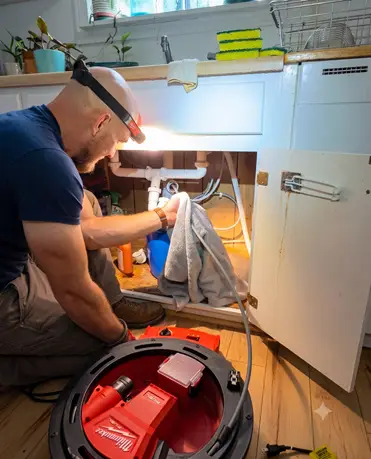

TennCo. Plumbing handles residential drain cleaning throughout West Tennessee, including Jackson, Lexington, Camden, Paris, Huntingdon, Parsons, along with Milan, Medina, Waverly, Savannah, and Decatur County. Our work is backed by licensed Journeyman credentials, TN LLP #4680.
Diagnostic Inspection
A camera inspection does more than confirm the line is clear. Once the pipe is open and the camera is inside it, the footage can show what the sewer line is made from, where it runs, whether roots are entering at a specific joint, and whether the pipe holds a belly, an offset, heavy scale, a crack, or a collapsed section. That information is what tells a homeowner whether they had a one-time blockage, a problem that will return, or a section of pipe that will eventually need repair.
Clearing the line restores flow. The camera helps explain why the blockage happened in the first place, and whether it is likely to come back.
Once the camera is in the line, the footage often shows what the pipe is made from. PVC, cast iron, clay, and Orangeburg each age differently and fail in different ways. Knowing the material tells a homeowner whether a blockage was a surface issue or the first sign of a pipe reaching the end of its service life. A clay line joined every few feet behaves nothing like a continuous run of PVC, and the material shapes what we recommend next.
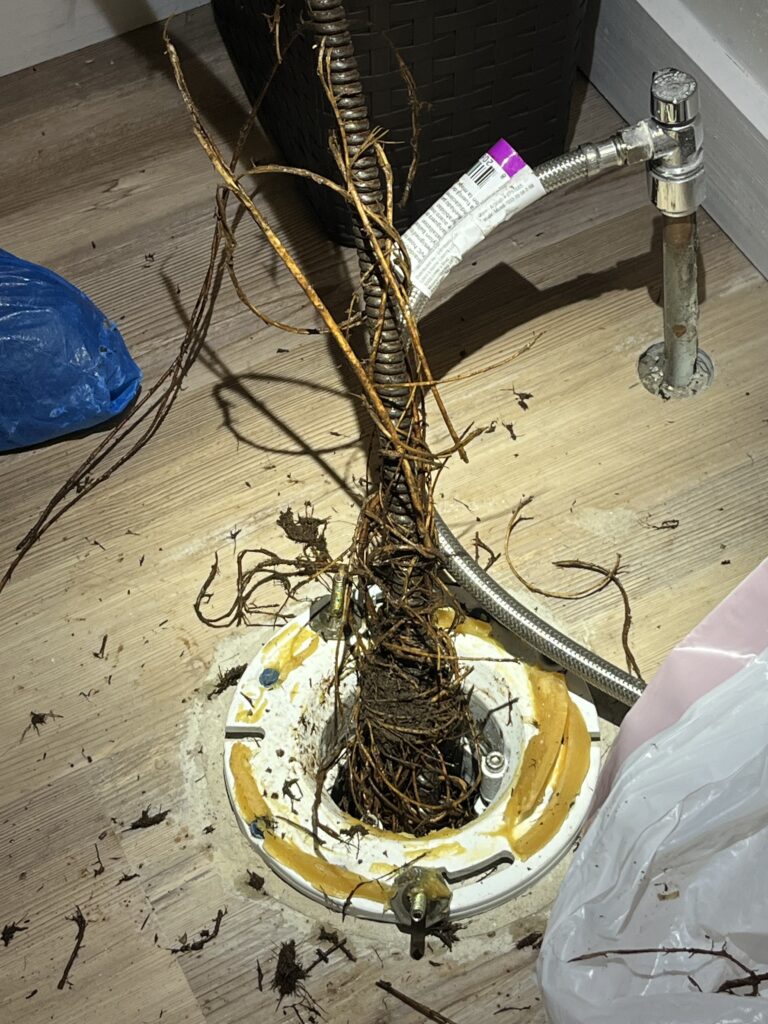
The useful finding is not that roots were present. It is where they entered and how much of the pipe they have taken over. Roots almost always come in at a joint or a crack, because that is where moisture escapes. A few fine roots at a single clay joint is a very different situation from a mass of roots filling the pipe across several sections. The camera shows which one you are dealing with, and that determines whether periodic cleaning will hold the line or whether the joint itself needs attention.
When part of a line settles below grade, water stops draining fully and stands in the low spot. On camera that shows up as a pool the flow has to push through. A belly catches waste and paper, so a line with a belly tends to back up again even after it is cleared. Standing water in the footage is one of the clearest signs that a blockage is likely to return rather than a one-time event.
An offset is a joint where two sections of pipe no longer line up cleanly. The lip that creates catches paper and debris the same way a belly does. Clearing the line removes what is caught today, but the offset stays, so the problem returns on its own schedule. Seeing the offset on camera is what separates a pipe that needs occasional maintenance from one that needs a repair at a specific point.
Older cast iron can still be structurally sound and yet carry a fraction of the water it once did. Over decades the interior builds up scale that narrows the opening and grabs anything passing through. The footage shows how much usable diameter is left. A four-inch cast iron line running at two inches of clear space behaves like a smaller pipe, and that explains repeat backups that have nothing to do with what the homeowner is putting down the drain.
Some findings tell us that more clearing will not fix the problem. A cracked section, a hole, or a length of pipe that has collapsed is a structural failure, not a blockage. When the camera shows this, we say so plainly. Running a cable through a broken pipe clears it for a short time, but the line will keep failing until the damaged section is repaired or replaced.
ROUTE + LOCATE
The camera works with a locator that traces where the line runs and how deep it sits. When a defect shows up on the footage, we can mark its position on the surface above. That matters before any repair, because it means the work can target the actual problem instead of guessing, and a homeowner knows where their sewer line travels across the property.
A single slow fixture or a routine clog usually does not call for a camera. A camera earns its place when a main line backs up and the cause is not obvious, when structural damage is suspected, or when the path of the line needs to be confirmed before other work. The TennCo. Plumbing team recommends a camera inspection based on what the line is doing, not because the equipment is in the truck. If your situation does not call for one, we will tell you.